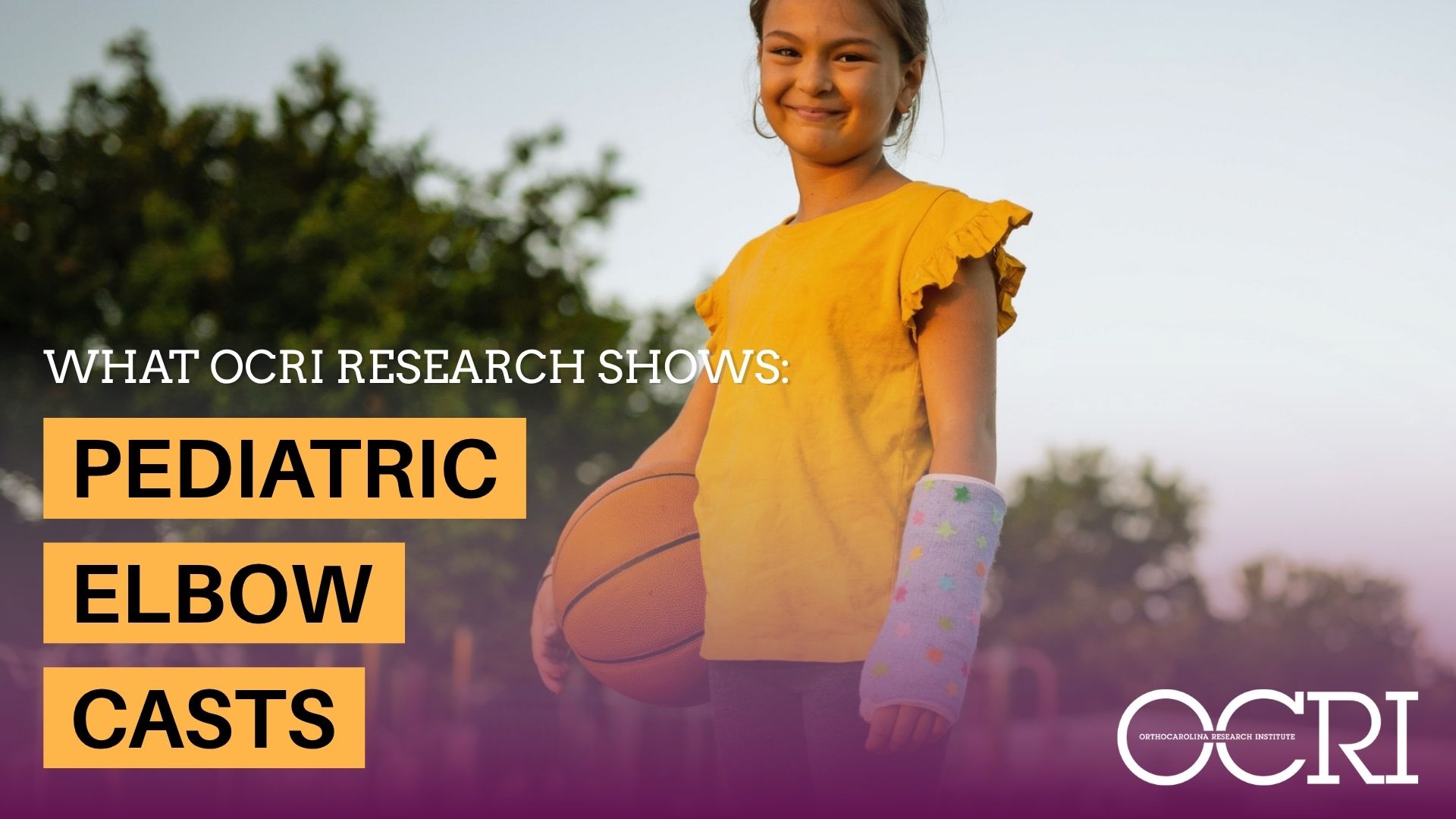
 When a child breaks an elbow, it brings difficult challenges to everyday activities.
A recent study from OrthoCarolina researchers asked:
Does a child’s cast really need to cover the wrist and hand after surgery for a supracondylar humerus fracture?
The answer may help make recovery a little easier for children and families.
Supracondylar humerus fractures are the most common elbow fractures in children. These injuries happen just above the elbow and are typically caused by a fall onto an outstretched arm.
Some children with these fractures need surgery to realign and stabilize the bone. After surgery, the arm is usually placed in a cast while the bone heals.
Traditionally, casts for this injury have included the wrist and hand. The idea was that including the hand could help limit movement and protect the healing fracture. But covering the wrist and hand can also make daily activities harder for the child.
This study looked at whether a less restrictive cast, one that still protects the elbow but leaves the wrist and hand free, could work just as well as the traditional, more limiting option.
Researchers compared two types of above-elbow casts used after surgery for pediatric supracondylar humerus fractures:
The study included children ages 3 to 10 who had isolated supracondylar humerus fractures treated surgically with pins. Researchers followed patients after surgery and measured various factors, including function, pain, range of motion, etc.
The wrist-and-hand-free cast performed just as well as the standard cast for healing and long-term recovery.
These findings stood out:
Children with the wrist-and-hand-free cast had better early function.
At the 3- to 4-week visit, children in the wrist-and-hand-free cast group had better function scores than children in the standard cast group.
Children with the wrist-and-hand-free cast had better hand dexterity while still in the cast.
Researchers used a peg board test to measure how quickly children could pick up and move small pegs. Children whose wrist and hand were free completed the test faster than children whose hand was included in the cast.
Pain was similar between groups.
Both groups reported very low pain scores during recovery.
Healing and alignment were similar between groups.
The less restrictive cast did not lead to worse fracture alignment, loss of reduction, or problems with healing.
No patients in the study experienced complications.
Importantly, the wrist-and-hand-free cast did not lead to cast slipping, fracture displacement, pin migration, or the need for revision surgery.
For a child, small differences in a cast can make a big difference in daily life.
Leaving the wrist and hand free gives children more flexibility to do things on their own while they heal. That can include simple but meaningful activities like eating, writing, playing, and washing their hands.
Hand hygiene may be another practical advantage. When the cast stops at the wrist, it is much easier for a child to wash their hands thoroughly. While this study did not look at whether that leads to fewer childhood illnesses, easier hand washing may make it simpler for families to keep up with good hygiene during recovery.
The study also points to another important benefit: when the wrist and hand are free, the care team can more easily check circulation in the hand after surgery. Being able to assess the pulse and hand perfusion is especially helpful during the early postoperative period.
In research, “non-inferior” means that one treatment is not worse than another by a meaningful amount.
In this study, the wrist-and-hand-free cast was found to be non-inferior to the standard cast. In plain language, that means the less restrictive cast provided similar results for healing, pain, function, and alignment, while also offering some early practical advantages.
The goal is not just to heal the fracture.
The goal is to help children heal safely while making recovery as manageable as possible.
Sometimes, research changes patient care by introducing a brand new concept, innovation, or technique to the medical community. Other times, it helps healthcare practitioners challenge the status quo and take a closer look at what they already do every day, like this study.
By studying cast type in a randomized way, researchers were able to determine whether children could safely have more freedom of movement without compromising healing by using a less traditional casting technique.
For children recovering from surgery for a supracondylar humerus fracture, an above-elbow cast that leaves the wrist and hand free was found to be a safe and practical alternative to a standard cast that includes the hand.
The study found similar healing, similar pain scores, similar long-term function, and no complications in either group. Children with the wrist-and-hand-free cast also showed better early function and better hand dexterity while still in the cast.
For patients and families, that may mean a recovery experience that is a little easier, a little more comfortable, and a little more functional, with better access to the hand for everyday activities and hand washing, without sacrificing healing.
Source: Graham GD, Chandler C, Gachigi K, Michalek C, Steinke J, Brighton B, Paloski M, Scannell B, Casey V. Above Elbow Casts with the Wrist and Hand Free vs. Standard Above Elbow Casts with the Wrist and Hand Included in the Treatment of Supracondylar Humerus Fractures in Children: A Randomized Prospective Study. Journal of the Pediatric Orthopaedic Society of North America. 2026. doi:10.1016/j.jposna.2026.100414.
Back

Essential cookies keep the site secure and functional. You can choose whether to allow non-essential cookies below.
Necessary
Required for security, navigation, and core site functionality. These always stay on.
Remember choices such as display preferences to improve your experience on return visits.
Help us understand how visitors use the site so we can improve performance and usability.
Support campaign tracking and embedded third-party tools that help us reach the right audience.