 As Pickleball gained popularity, doctors at OrthoCarolina noticed more pickleball-related injuries in their practices, especially Achilles tendon injuries.
Because all of OCRI’s research is inspired by patients like you, a recent study looked at Achilles tendon ruptures in people who were injured while playing pickleball, tennis, and other sports. The goal was not to scare people away from the game, but answer an important question for patients, “As more adults play pickleball, are we really seeing more injuries? And what can patients do to prevent specific racket sport-related injuries?”
The Achilles tendon connects the calf muscles to the heel bone. It helps power movements like pushing off, sprinting, jumping, and changing direction. Those are exactly the kinds of movements needed to play pickleball.
Although pickleball may appear to be a lower-impact option vs. basketball, soccer, or even tennis, it still involves quick starts and stops, lunges, and pivots toward the ball. For many players, especially adults returning to activity or increasing activity after time away, those movements can place sudden stress on the Achilles tendon.
This study shows that pickleball-related Achilles tendon tears are not just happening in the traditional “young athlete” population. They are showing up most often in adults over 50.
RELATED ARTICLE: Don’t Let Pickleball Sideline You: Research reveals injury insights
OCRI reviewed and compared Achilles tendon repairs performed between 2018 and 2022.
A few findings stood out:
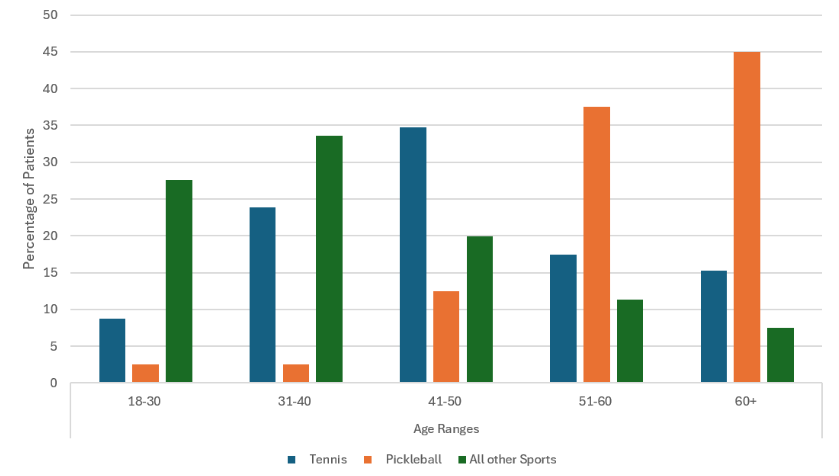
This figure shows how Achilles tendon ruptures differed by age group. In this study, pickleball-related ruptures were concentrated in older age groups, especially patients over 50.
This research is not saying, “Do not play pickleball.” In fact, staying active is one of the best things people can do for their health.
What the study does suggest is that pickleball players, especially those over 50, should recognize that the sport can be more physically demanding than it first appears. A smaller court and an underhand serve may make the game feel accessible, but the body still has to react quickly. The Achilles tendon may be placed under sudden load during a fast push-off, pivot, or lunge.
That means prevention matters.
For patients, the message is simple: You do not need to stop playing. You do need to prepare your body to play.
While no warm-up can prevent every injury, a few habits may help reduce risk:

This figure shows how the percentage of Achilles repairs related to pickleball changed over time in the study period. The increase reflects a changing injury pattern as more adults took up the sport.
This study helps doctors, physical therapists, athletic trainers, and patients better understand who may be at risk and how to have more informed conversations about prevention, preparation, and treatment.
It also gives researchers a starting point for future studies. The next step is learning more about which factors — such as conditioning level, frequency of play, footwear, court surface, previous tendon pain, or medical history — may increase or decrease the risk of injury.
Pickleball is a great way to stay active, competitive, and connected. This research does not suggest that patients should avoid the sport. It does suggest that players, especially adults over 50, should treat pickleball like the athletic activity it is.
A good warm-up, smart conditioning, supportive footwear, and listening to your body can go a long way.
The goal is not just to play more pickleball.
The goal is to keep playing safely.
—
Source: Padley JH, Averkamp B, Rieker M, Kalbac T, Murawski CD, Lendrum JA, Rennard J, Rees A, Hietpas K, Jones CP, Irwin TA, Shawen SB, Ellington JK, Ford SE. Pickleball-Associated Achilles Tendon Ruptures: Shifting Achilles Repair Demographics. Foot & Ankle Orthopaedics. 2026;11(1). doi:10.1177/24730114261425665
Back

Essential cookies keep the site secure and functional. You can choose whether to allow non-essential cookies below.
Necessary
Required for security, navigation, and core site functionality. These always stay on.
Remember choices such as display preferences to improve your experience on return visits.
Help us understand how visitors use the site so we can improve performance and usability.
Support campaign tracking and embedded third-party tools that help us reach the right audience.